

Drilling Mud Viscosity Guide for Bentonite Users
Related Article for Bentonite for Drilling Mud
Drilling Mud Viscosity Guide for Bentonite Users
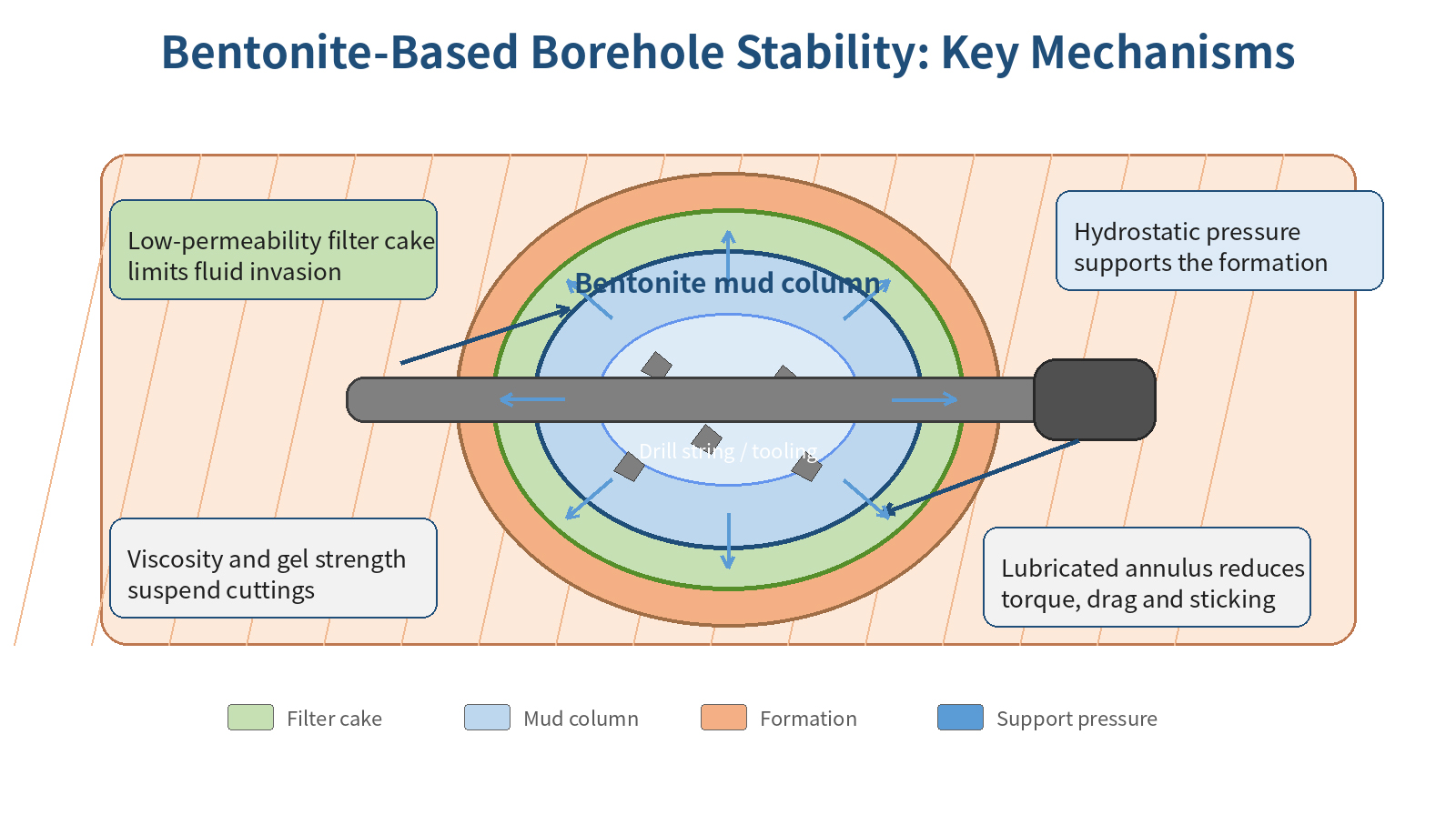
Bentonite is not simply a thickening powder. In drilling mud, it builds a controlled flow structure that helps carry cuttings, suspend solids during pump shutdowns, support the borehole wall, limit fluid loss and keep the system pumpable. This guide explains how bentonite users should understand, measure and adjust drilling mud viscosity for oilfield drilling, HDD, water wells, piling, mineral exploration and civil slurry applications.
| SEO item | Recommended content |
| Meta title | Drilling Mud Viscosity Guide for Bentonite Users | Bentonite Mud |
| Meta description | Learn how bentonite controls drilling mud viscosity, Marsh funnel readings, rheology, mixing quality and field troubleshooting for stable boreholes. |
| Suggested URL slug | /drilling-mud-viscosity-guide-bentonite-users |
| Primary keyword | drilling mud viscosity |
| Secondary keywords | bentonite viscosity, Marsh funnel viscosity, bentonite drilling mud, HDD mud viscosity, drilling fluid rheology |
| Search intent | Technical buying guide / field operation guide |
1. What viscosity means in a bentonite drilling mud system
In the field, viscosity usually refers to how thick the mud appears when it flows through a Marsh funnel. That reading is useful because it is quick, low-cost and easy to repeat. However, bentonite mud is a non-Newtonian fluid, so one number cannot describe the whole system.
· Marsh funnel viscosity is a comparison value expressed in seconds per quart, not a complete rheological diagnosis.
· Plastic viscosity is associated with solids loading and mechanical resistance to flow.
· Yield point indicates the mud's ability to initiate movement and carry cuttings under circulating conditions.
· Gel strength shows how well the mud suspends cuttings when circulation stops and how much pressure may be needed to restart circulation.
· Filtration and filter-cake quality must be checked together with viscosity because a thick mud can still be a poor sealing mud.
Technical distinction
For bentonite users, the operational question is not "How thick can the mud become?" but "Does the mud have enough viscosity and gel structure to clean and stabilize the borehole without creating unnecessary pump pressure?"
2. Why bentonite increases viscosity
Sodium bentonite contains swelling clay minerals that hydrate in fresh water and disperse into very fine plate-like particles. When properly hydrated, these particles form a colloidal structure. This structure increases apparent viscosity, develops gel strength and helps create a thin filter cake on permeable borehole walls.
The same bentonite can perform differently depending on water quality, shear energy, mixing order and hydration time. Hard water, salt contamination, low pH, cement contamination and poor mixing can suppress hydration and reduce yield. Conversely, over-treatment, high reactive clay solids or excessive polymer can make mud too viscous and difficult to pump.
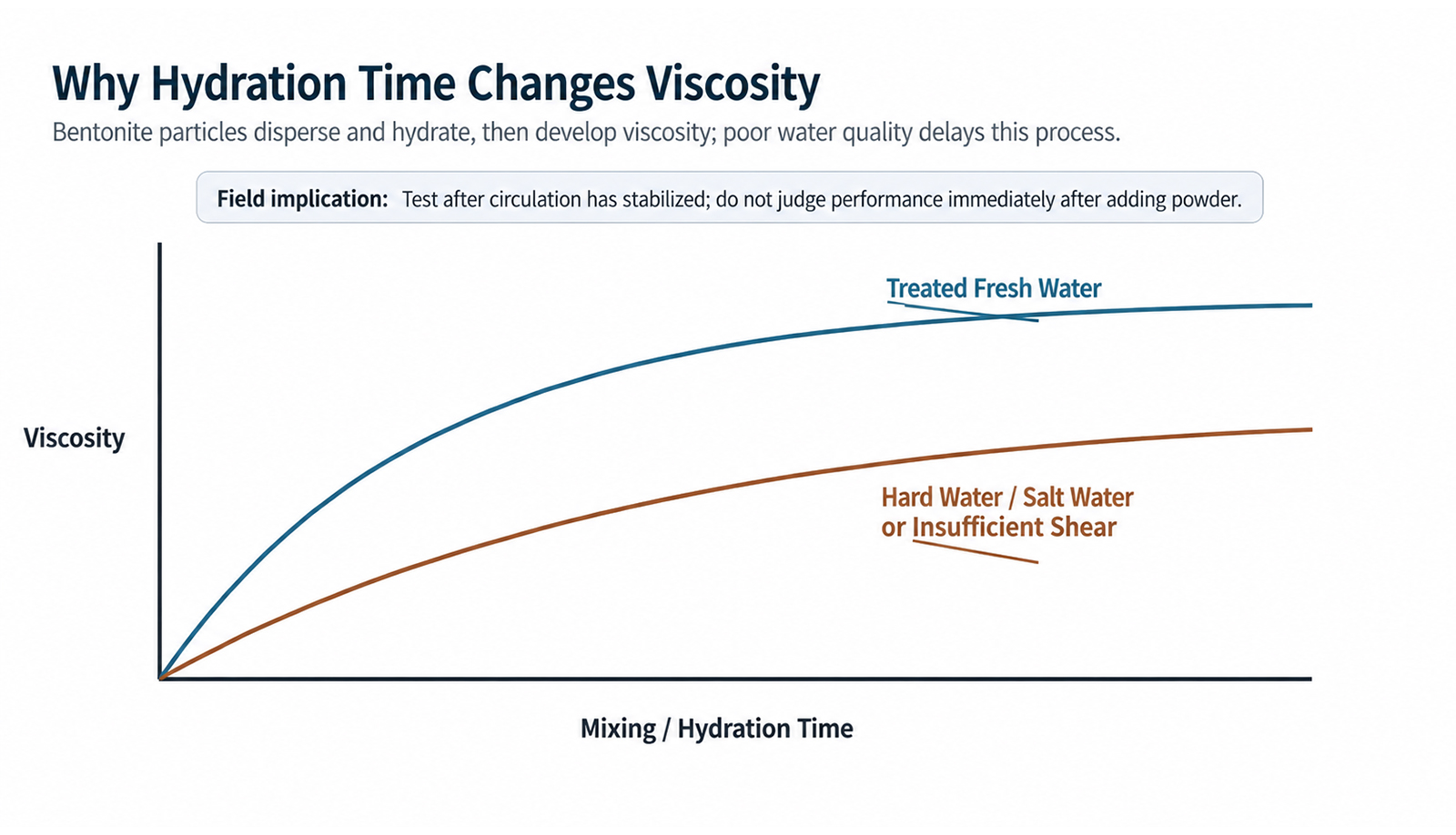
Figure 2. Bentonite viscosity develops over time; poor water quality or insufficient shear delays hydration.
3. Marsh funnel viscosity: useful but limited
The Marsh funnel is the most common field tool for routine mud viscosity checks. It measures the time required for a fixed volume of mud to flow through a standard funnel. A properly calibrated funnel should drain one quart of fresh water in about 26 seconds at the specified test temperature. Because the result depends on density, temperature, solids and flow behavior, it should be treated as a trend indicator rather than a laboratory viscosity value.
1. Collect a fresh, representative mud sample from the active system.
2. Check that the funnel screen and orifice are clean.
3. Fill the funnel to the screen level while keeping the outlet closed.
4. Start the stopwatch when the outlet is opened and stop when one quart has filled the cup.
5. Record both the funnel time and mud temperature. A reading without temperature is incomplete.
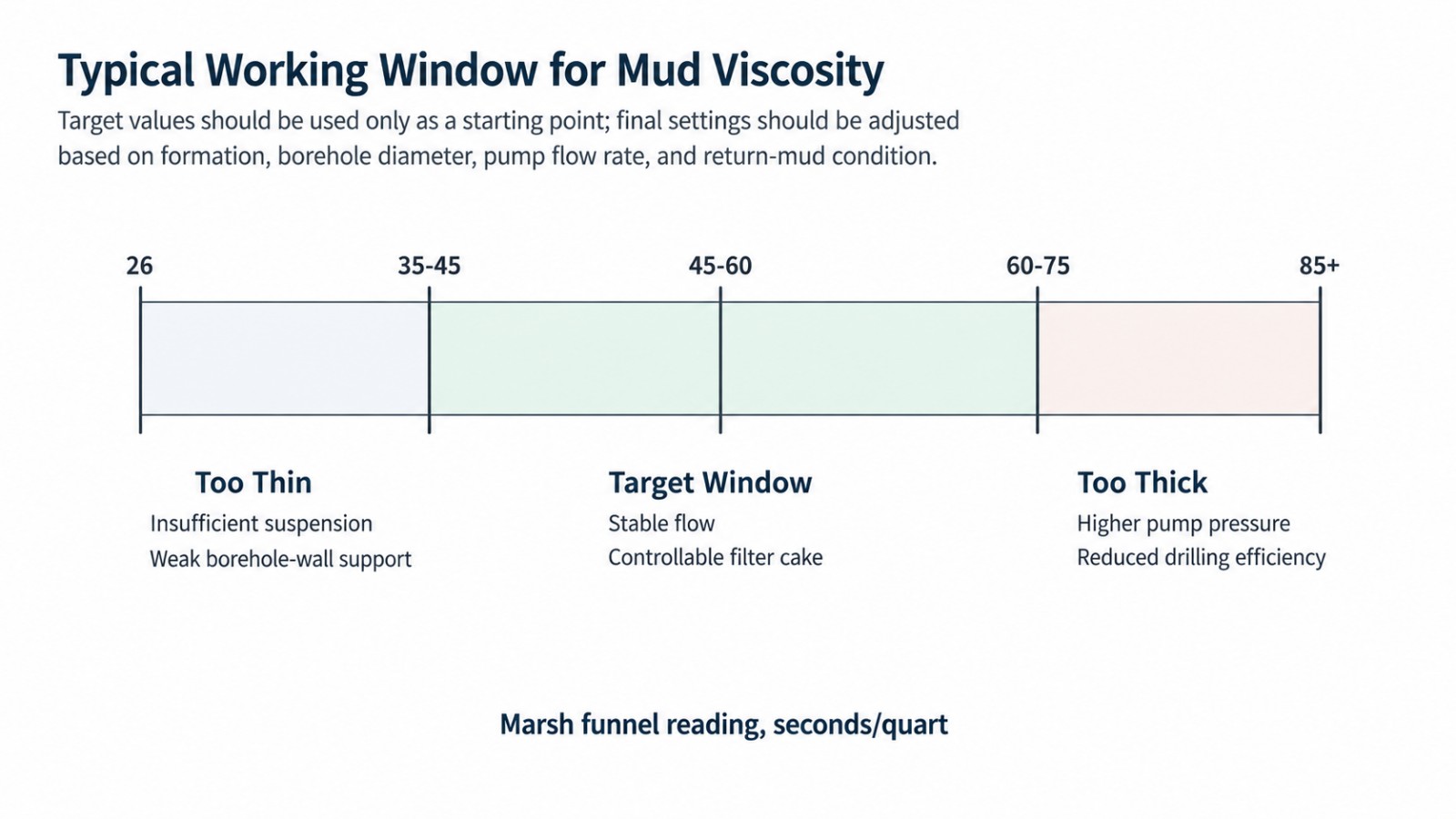
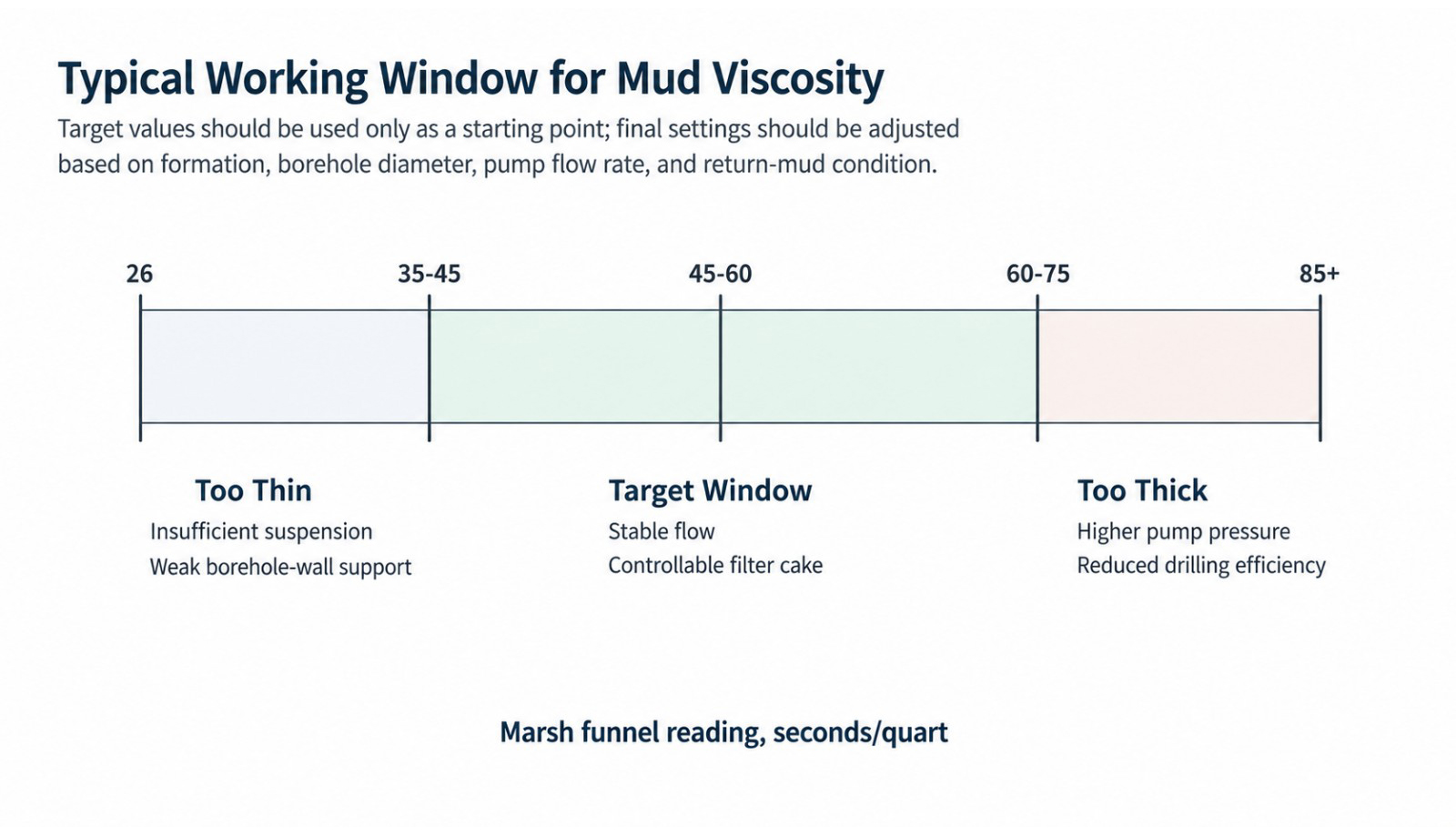
Figure 3. A practical viscosity window balances hole cleaning, wall support and pumpability.
4. Practical viscosity guide by project type
The ranges below are starting points for planning and site discussion. They are not universal specifications. Final values should be set by the drilling program, formation behavior, annular velocity, hole diameter, pump capacity, environmental limits and project owner requirements.
| Application | Typical starting Marsh funnel range | What the value is trying to control | Adjustment emphasis |
| Oilfield / gas drilling, top-hole or simple water-based mud | 32-45 s/qt | Initial hole cleaning, surface-hole stability and manageable pump pressure | Confirm with mud engineer; monitor density, PV/YP, gel strength and filtrate |
| Horizontal directional drilling in fine sand or mixed soils | 40-60 s/qt | Suspension of cuttings, borehole support and pullback lubrication | Treat water first; increase viscosity when returns carry excessive sand |
| HDD in coarse sand, gravel or cobbles | 60-80+ s/qt | Higher carrying capacity and reduced loss of circulation | Use high-yield bentonite, polymers or LCM as specified |
| Water well drilling | 35-50 s/qt | Cuttings transport and temporary wall support without over-thick filter cake | Avoid excessive solids before screen installation and development |
| Mineral exploration / geotechnical drilling | 38-55 s/qt | Core-hole cleaning, wall stabilization and sample protection | Keep viscosity high enough for returns but low enough for penetration |
| Bored piling / diaphragm wall slurry | Project specification dependent | Excavation support, sand suspension and filter-cake control | Follow project viscosity, density, sand content and fluid-loss requirements |
5. How to adjust low viscosity
Low viscosity usually appears as watery returns, poor cutting suspension, sand settling in pits, unstable borehole walls or excessive fluid invasion. Before adding more product, identify the reason for the low reading.
| Symptom | Likely cause | Field correction |
| Freshly mixed mud stays thin | Insufficient hydration time or low shear mixing | Circulate longer; add bentonite slowly into a strong vortex |
| Bentonite dosage is high but viscosity remains low | Hard water, salt or low pH suppressing hydration | Pre-treat makeup water with soda ash where appropriate; avoid salt water if the bentonite grade is not designed for it |
| Viscosity drops during drilling | Dilution, formation water inflow or contamination | Check pH, salinity and density; rebuild mud properties in the active system |
| Returns carry sand poorly | Viscosity and gel strength are below cleaning requirement | Increase bentonite concentration gradually; consider polymer only after bentonite is hydrated |
| High fluid loss despite acceptable funnel value | Poor filter cake or insufficient fine solids structure | Check filtration; use suitable filtration-control additive or better bentonite grade |
6. How to correct excessive viscosity
Excessive viscosity is not a sign of better mud. It can raise circulating pressure, slow penetration, increase surge and swab risks, overload mixing equipment and make solids removal less efficient. In HDD and civil slurry work, it can also increase the probability of surface breakout or disposal difficulties.
| Symptom | Likely cause | Field correction |
| Funnel time climbs quickly while drilling | Reactive formation clay or drilled solids accumulation | Improve solids control, dilute with conditioned water and avoid unnecessary polymer |
| Pump pressure rises after polymer addition | Polymer added before bentonite hydration or overdosed | Stop polymer addition, dilute carefully and restore mixing sequence |
| Mud gels hard after shutdown | Excessive gel strength or flocculation | Check contaminants; condition chemistry; avoid leaving dirty mud static |
| Viscosity unstable between tests | Temperature variation or poor sample consistency | Measure temperature and sample from the same active point |
| Thick mud still loses fluid | Viscosity is high but filter cake is poor | Do not solve filtration only with viscosity; test filtrate and use compatible additives |
7. Mixing sequence that protects bentonite yield
Most viscosity problems begin before the mud reaches the borehole. The practical sequence is simple: condition the water, add bentonite slowly, allow hydration, then add polymers or specialty additives if needed. Reversing this order often causes fisheyes, balling, low yield and unstable viscosity.
1. Start with clean makeup water. Test pH, hardness, chloride/salinity and temperature.
2. Adjust water chemistry before adding bentonite when the product and project specification require it.
3. Add bentonite slowly into the mixing vortex; do not dump full bags into stagnant water.
4. Maintain agitation and circulation until the viscosity stabilizes.
5. Add polymers, lubricants, loss-control materials or other additives only after bentonite is sufficiently hydrated unless the supplier procedure states otherwise.
6. Record dosage, mixing time, Marsh funnel viscosity, density, pH and temperature for every batch.
8. Reading viscosity together with other mud properties
A reliable mud program does not manage funnel viscosity in isolation. The following properties should be evaluated together because they explain different parts of mud performance.
| Property | What it tells the field team | Risk if ignored |
| Density / mud weight | Hydrostatic support and solids loading | Kick risk, losses or excessive pump pressure |
| Marsh funnel viscosity | Quick trend of relative thickness | Overreacting to one number without knowing rheology |
| Plastic viscosity | Mechanical resistance from solids and liquid phase | High pressure and poor hydraulics |
| Yield point | Ability to carry cuttings under flow | Cuttings beds, poor hole cleaning |
| Gel strength | Suspension after shutdown and restart pressure | Settling, stuck pipe or pressure spikes |
| Filtration / filter cake | Wall sealing and fluid invasion behavior | Unstable borehole even when viscosity looks acceptable |
| pH and hardness | Bentonite hydration environment | Low yield, flocculation or chemical instability |
9. Procurement checklist for bentonite users
For website buyers, viscosity guidance should connect product selection with measurable field outcomes. When evaluating bentonite for drilling mud, request more than a product name.
· Confirm whether the product is natural sodium bentonite, activated bentonite or a blended drilling-grade formulation.
· Ask for typical Marsh funnel viscosity at stated dosage, water quality and hydration time.
· Request API/ISO-related test information where applicable, including yield, filtration and residue data.
· Check compatibility with polymers, lubricants, soda ash, salts, cement contamination and local makeup water.
· Ask for recommended dosage ranges by formation: clay, fine sand, coarse sand, gravel, mixed ground or rock.
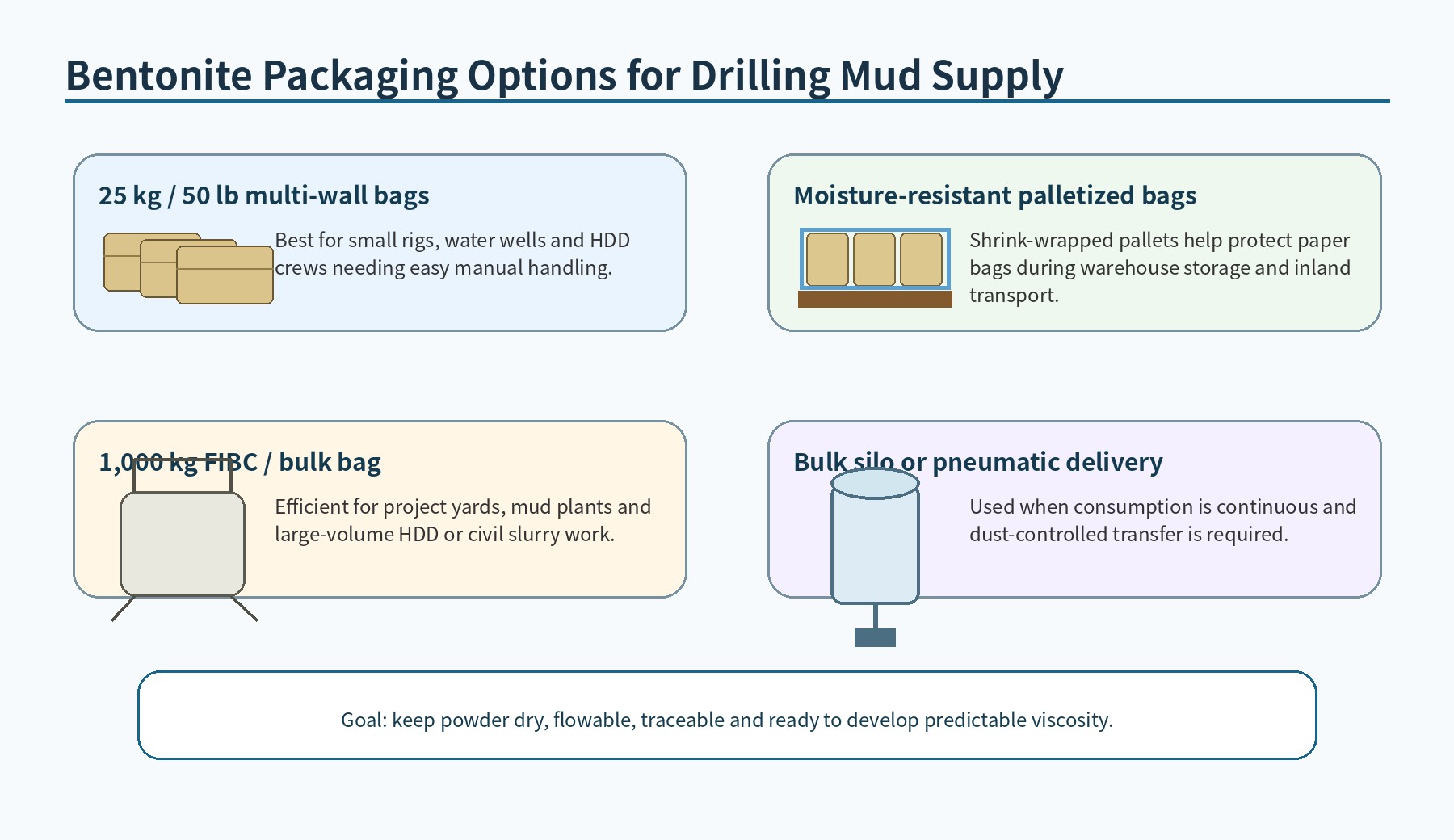
· Verify packaging, storage moisture control, shelf life and batch-to-batch consistency.
· For HDD and civil works, request an environmental and disposal statement suitable for project submittals.
10. Common mistakes to avoid
· Choosing bentonite only by price per ton instead of yield per cubic meter of usable mud.
· Using a single Marsh funnel target for every formation and hole size.
· Adding polymer before bentonite has hydrated.
· Ignoring hard water, salt or low pH while blaming the bentonite grade.
· Treating high viscosity as automatically safer.
· Failing to record mud temperature with viscosity readings.
· Trying to fix filtration, lubricity and borehole instability with viscosity alone.
FAQ
What is a good drilling mud viscosity for bentonite?
There is no single good value. Many bentonite water-based muds begin around 35-60 seconds per quart on a Marsh funnel, but HDD gravel, large annuli or unstable ground may require higher values. Project specifications and field response should govern the final target.
Does higher bentonite dosage always mean better viscosity?
No. Bentonite only yields well when water quality, shear and hydration time are suitable. Excess dosage can increase pressure and solids load without improving borehole performance.
Can Marsh funnel viscosity replace a rheometer?
No. It is a quick comparison tool. Critical operations should also consider rheometer values such as plastic viscosity, yield point and gel strength.
Why did my mud lose viscosity after drilling started?
Common causes include dilution, formation water, salt contamination, cement contamination, high solids, temperature changes or poor mixing discipline.
Should polymers be mixed before bentonite?
Usually no. In most bentonite systems, bentonite should hydrate first. Polymers added too early can coat particles and reduce yield, unless the supplier's procedure specifies a different sequence.