

How Bentonite Improves Borehole Stability
Related Article for Bentonite for Drilling Mud
How Bentonite Improves Borehole Stability
Borehole stability is one of the most important performance targets in mud rotary drilling, horizontal directional drilling, water well construction, geotechnical drilling, bored piling and slurry-supported excavation. A borehole is stable when the drilled formation remains open long enough for drilling, sampling, casing, pipe installation or concreting to proceed without excessive caving, collapse, swelling, fluid loss or stuck tooling. In many formations, that stability is not achieved by mechanical equipment alone. It depends on the engineering behavior of the drilling fluid.
Bentonite for drilling mud is widely used because hydrated bentonite can build viscosity, form a thin filter cake, reduce uncontrolled filtration, suspend cuttings and provide a lubricating slurry film along the borehole wall. These functions are especially valuable in loose sand, gravelly soils, weathered rock, mixed ground and other formations that do not naturally stand open after excavation.
Technical diagram: bentonite-based borehole support
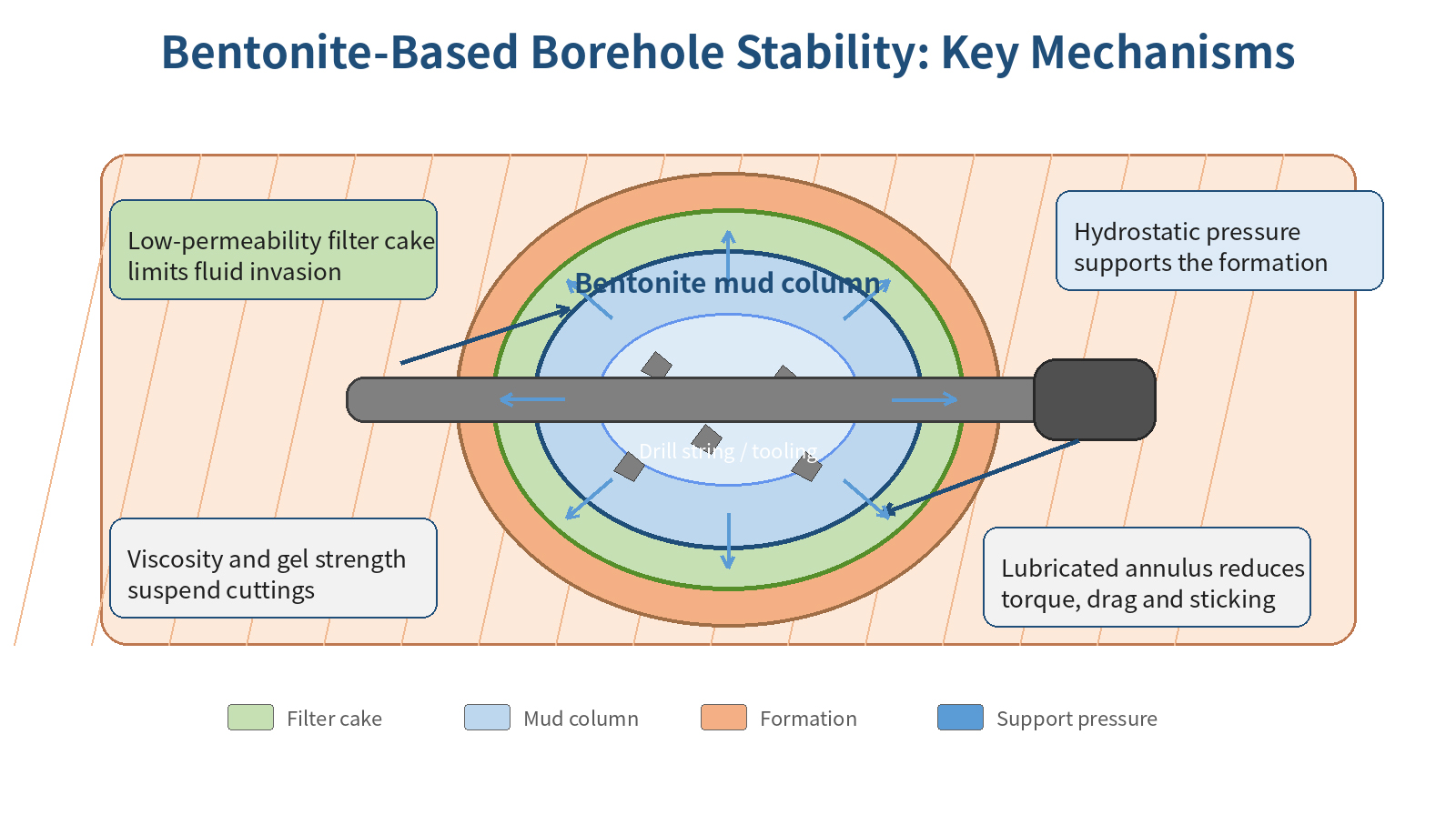
Figure 1. A bentonite drilling mud system improves borehole stability through filter cake, hydraulic support, cuttings suspension and lubrication.
1. Filter cake formation seals the borehole wall
The most direct stabilizing mechanism of bentonite drilling mud is filter cake formation. When drilling fluid contacts a permeable formation, water tends to move into the pores of the formation. Hydrated bentonite platelets and other fine solids remain at the borehole face and build a thin, low-permeability layer. This layer is called the filter cake.
A good filter cake is not simply a thick layer of clay. In drilling practice, the target is usually a thin, tough and low-permeability membrane. This membrane reduces fluid invasion, helps maintain mud pressure at the borehole face and limits the washing-out of unconsolidated particles. In sand and gravel, where fluid can otherwise drain away quickly, a competent bentonite filter cake can be the difference between a controlled bore and a collapsing annulus.
2. Viscosity and gel strength keep cuttings under control
Bentonite improves the carrying capacity of drilling mud. After hydration, sodium bentonite develops a colloidal slurry with viscosity and gel strength. Viscosity helps transport drill cuttings while circulation is active. Gel strength helps suspend solids when pumping slows or stops. This matters because settled cuttings can accumulate at the bottom of the hole, restrict annular flow, increase torque and drag, and create stuck-pipe or stuck-tool conditions.
The stabilizing value of cuttings transport is often underestimated. A borehole wall can fail not only because the formation is weak, but also because the annulus becomes overloaded with solids. Properly hydrated bentonite mud keeps the annulus cleaner, reduces regrinding of cuttings and maintains a more consistent hydraulic environment around the borehole.
3. Hydrostatic pressure supports the formation
A bentonite mud column exerts hydrostatic pressure against the borehole wall. When that pressure is properly controlled, it helps counteract groundwater pressure and the inward movement of loose or weak formation material. In civil slurry systems, bored piles and diaphragm wall construction, this positive slurry pressure is a primary reason bentonite is used to support open excavations before concrete placement.
Pressure must be managed carefully. Too little support pressure may allow caving or collapse; too much annular pressure can cause hydraulic fracturing, fluid loss or inadvertent returns in HDD and trenchless work. Bentonite helps by providing a pumpable fluid with the right balance of density, viscosity and filtration control, but the final pressure window still depends on ground conditions, depth, fluid properties and operating practice.
4. Fluid-loss control protects the stability envelope
Excessive fluid loss can destabilize a borehole in two ways. First, it removes the fluid pressure needed to support the borehole wall. Second, it allows filtrate to invade the formation, which can soften clays, disturb weak zones or wash fine particles from granular soils. Bentonite reduces these risks by controlling filtration through the filter cake.
In difficult formations, bentonite may be used with polymers or fluid-loss additives. The goal is not to make the mud as thick as possible; the goal is to engineer a fluid that pumps efficiently while controlling filtrate, building a stable wall cake and carrying solids to the surface.
5. Lubrication reduces mechanical disturbance
Borehole instability is not only a geotechnical issue. It can also be triggered by mechanical disturbance from rotating rods, reamers, casing, drill strings or product pipe. Bentonite slurry creates a lubricating film that reduces friction between tooling and the borehole wall. In HDD, microtunneling and pipe jacking, this lubrication can reduce pullback loads and limit wall damage during reaming or product installation.
Lower friction also contributes to operational stability. When torque, drag and sticking are reduced, the drilling crew can maintain steadier circulation and tool movement, which helps avoid pressure spikes and localized erosion of the borehole wall.
Mechanism summary
| Bentonite function | How it supports borehole stability | Practical result |
| Filter cake | Builds a thin, low-permeability layer on permeable formations. | Limits fluid invasion and helps hold mud pressure at the wall. |
| Viscosity | Improves carrying capacity while the mud is circulating. | Moves cuttings out of the hole and reduces annular loading. |
| Gel strength | Suspends solids when circulation slows or stops. | Reduces cuttings settlement and stuck-tool risk. |
| Hydrostatic support | Applies positive slurry pressure against the formation. | Helps resist caving, sloughing and groundwater inflow. |
| Fluid-loss control | Controls filtrate movement through the wall cake. | Reduces washout, softening and loss of support pressure. |
| Lubrication | Forms a slick slurry film around tooling and pipe. | Reduces torque, drag, abrasion and wall disturbance. |
Application-specific benefits
| Application | Why borehole stability matters | Role of bentonite drilling mud |
| Oilfield and gas drilling fluids | Wellbore instability can lead to tight hole, stuck pipe, poor hole cleaning and non-productive time. | Bentonite contributes viscosity, gel structure, filtration control and a base fluid framework for water-based mud systems. |
| Water well drilling | Unconsolidated sands and gravels may cave before screen and casing installation. | Bentonite mud supports the hole, carries cuttings and helps control fluid loss during drilling. |
| Horizontal directional drilling | A stable annulus is needed for steering, reaming and product pullback. | Bentonite builds wall cake, lubricates the bore path and helps suspend cuttings in long annular sections. |
| Bored piling and diaphragm walls | Open excavations must remain stable until reinforcement and concrete are placed. | Bentonite slurry provides positive hydrostatic support and reduces seepage through the excavation face. |
| Mineral exploration and geotechnical drilling | Core recovery and borehole quality depend on controlled wall conditions. | Bentonite helps reduce wall sloughing and keeps cuttings from settling around rods and tools. |
| Trenchless and civil slurry systems | Ground loss, fluid loss and wall collapse can affect alignment and surface settlement. | Bentonite stabilizes the annulus or trench, improves lubrication and supports predictable slurry behavior. |
Selection and mixing practices that affect stability
Bentonite performance depends on both product quality and field practice. A high-quality sodium bentonite usually hydrates more effectively than low-swelling calcium bentonite, but even a good product can underperform if it is mixed into hard, salty or chemically contaminated water without treatment. Cement contamination, high calcium hardness, excessive drilled solids and poor hydration time can all reduce viscosity and filtration performance.
· Use drilling-grade bentonite that is suitable for the target application and aligned with relevant project specifications.
· Pre-treat mix water when hardness, salinity or pH prevents proper hydration.
· Add bentonite slowly through a high-shear mixer or venturi hopper to avoid fish-eyes and dry clumps.
· Allow adequate hydration time before evaluating viscosity, gel strength or fluid-loss behavior.
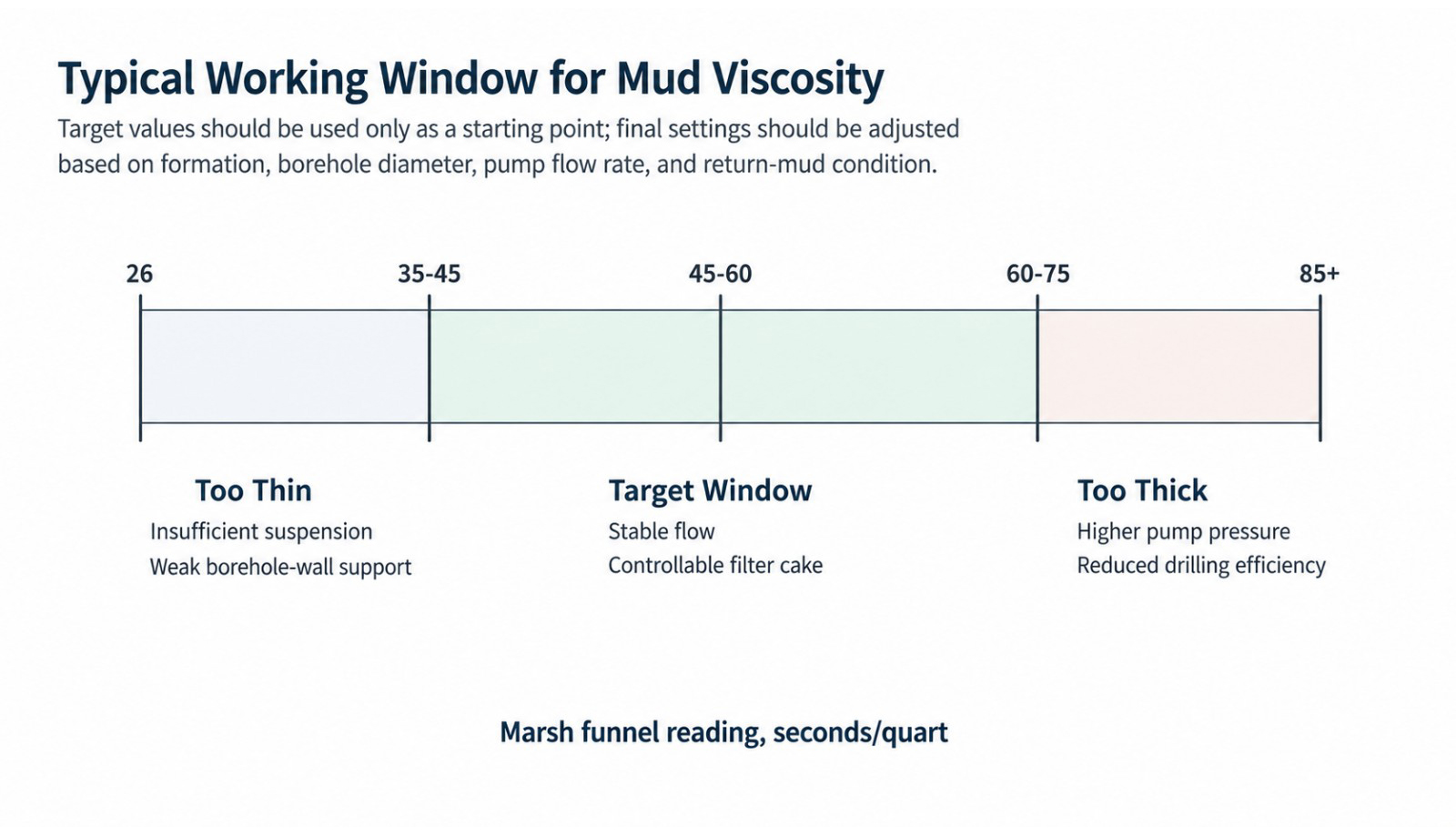
· Monitor Marsh funnel viscosity, mud weight, pH, sand content, filtrate loss and, where required, rheometer readings.
· Control drilled solids; excessive solids can create thick, unstable mud that does not clean or support the hole efficiently.
Common problems when bentonite mud is not managed correctly
| Problem | Likely cause | Stability impact |
| Caving or sloughing | Mud too thin, poor filter cake, insufficient support pressure or unstable formation. | Borehole diameter enlarges; tooling may bind or become stuck. |
| High fluid loss | Inadequate bentonite hydration, coarse formation, contamination or insufficient fluid-loss control. | Support pressure drops; filtrate invasion and washout increase. |
| Excessive torque and drag | Poor lubrication, cuttings beds or overloaded annulus. | Wall disturbance increases and pullback or casing operations become harder. |
| Thick but ineffective mud | Too many drilled solids or poor solids control. | Pump pressure rises while hole cleaning and filter cake quality deteriorate. |
| Poor hydration | Hard water, salt, cement contamination or improper mixing order. | Bentonite yield is reduced and the mud cannot develop the intended viscosity or wall cake. |
Conclusion
Bentonite improves borehole stability because it works as both a fluid and a wall-support material. It builds viscosity for cuttings transport, gel strength for suspension, a low-permeability filter cake for filtration control, hydrostatic pressure for wall support and lubrication for smoother drilling. For contractors and drilling-fluid buyers, the key is not simply to use more bentonite, but to use the right drilling-grade bentonite, mix it correctly and verify mud properties throughout the job.
When engineered properly, bentonite drilling mud helps reduce collapse risk, fluid loss, stuck tooling, poor hole cleaning and non-productive time. That makes it one of the most practical and cost-effective materials for borehole stability across oilfield, water well, HDD, piling, geotechnical and civil slurry applications.
FAQ
Why is bentonite used to stabilize boreholes?
Bentonite hydrates in water to form a viscous slurry that can create a low-permeability filter cake, suspend cuttings and apply positive fluid pressure against the borehole wall.
Does thicker mud always mean better borehole stability?
No. Mud that is too thick may increase pump pressure, reduce penetration rate and carry excessive drilled solids. Stable drilling usually requires balanced viscosity, gel strength, filtration control and solids management.
What is a filter cake in drilling mud?
A filter cake is a thin layer of bentonite and fine solids that forms on the borehole wall as filtrate passes into the formation. A good wall cake reduces fluid loss and helps maintain support pressure.
Can bentonite prevent borehole collapse in all formations?
No drilling fluid can guarantee stability in every formation. Severe lost circulation, highly fractured rock, flowing sand or reactive shale may require polymers, additives, casing, pressure control or changes in drilling method.
Why is sodium bentonite preferred for drilling mud?
Sodium bentonite usually has higher swelling capacity and better yield in water, making it more effective for viscosity building and filter cake formation than many calcium bentonites.
How should bentonite mud be tested on site?
Common field checks include Marsh funnel viscosity, mud density, pH, sand content and visual condition. More technical programs may include API fluid-loss testing, rheometer readings and gel-strength measurements.